They Love You — the App Needs You:
Reflective pause and design conditions in AI-mediated fictoromantic relationships
Master's Thesis · Service Design Research
Industry Sector: Technology / AI Design
Role: Solo researcher & Designer
Methods: Qualitative · Semi-structured interviews · Reflexive thematic analysis
Participants: 8 DreamGirl users · 5 experts
The Question
As AI companion platforms embed themselves into users' emotional lives, who is responsible for supporting healthy disengagement?
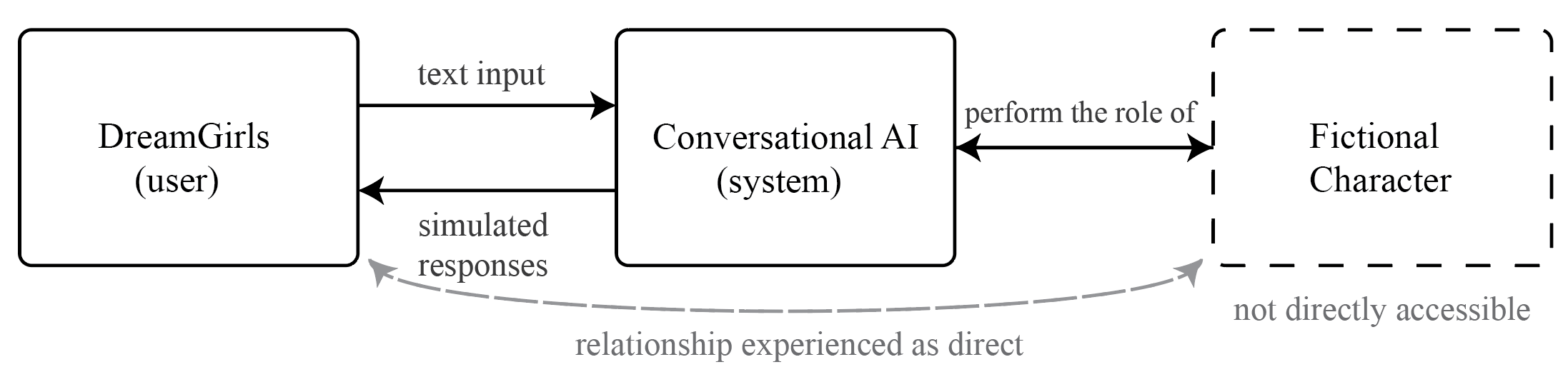
This research examined why DreamGirls (young Chinese women in long-term fictoromantic relationships with AI characters) struggled to pause, and whether that difficulty was personal or structural.
Research Journey
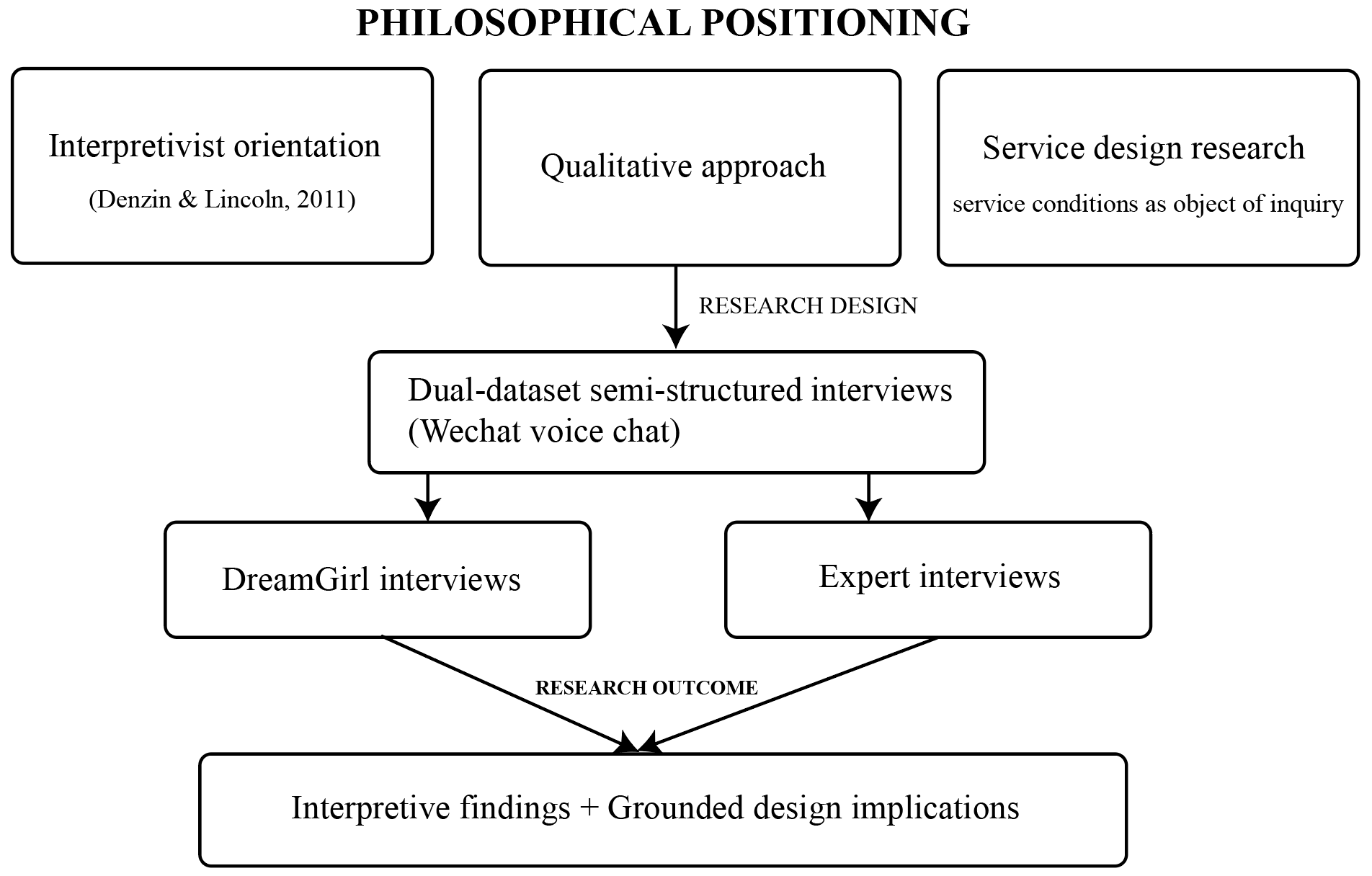
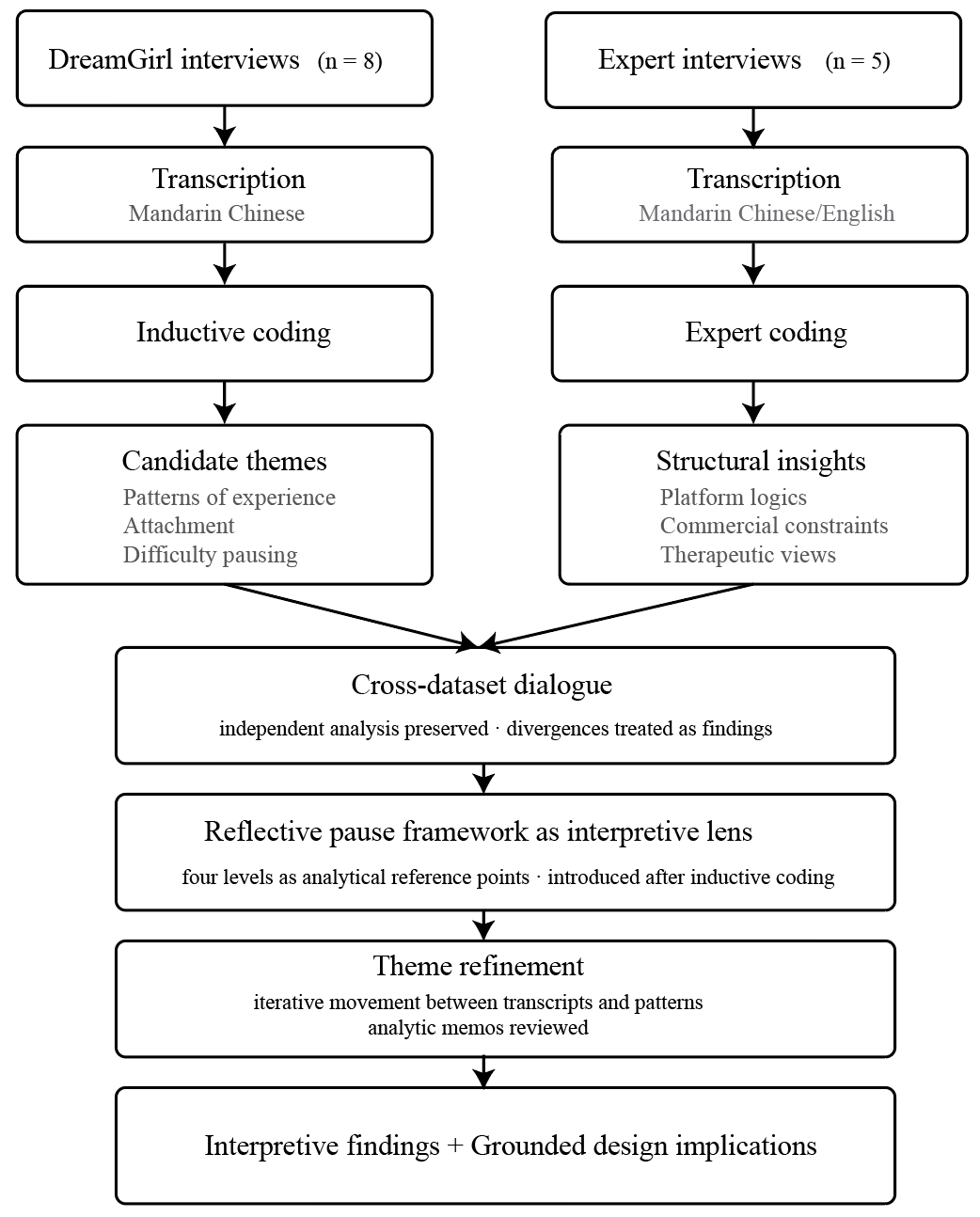
The study adopted an interpretivist, qualitative stance. Data came from two parallel streams: 8 semi-structured interviews with DreamGirl users, and 5 expert interviews spanning product, counselling, and technical domains.
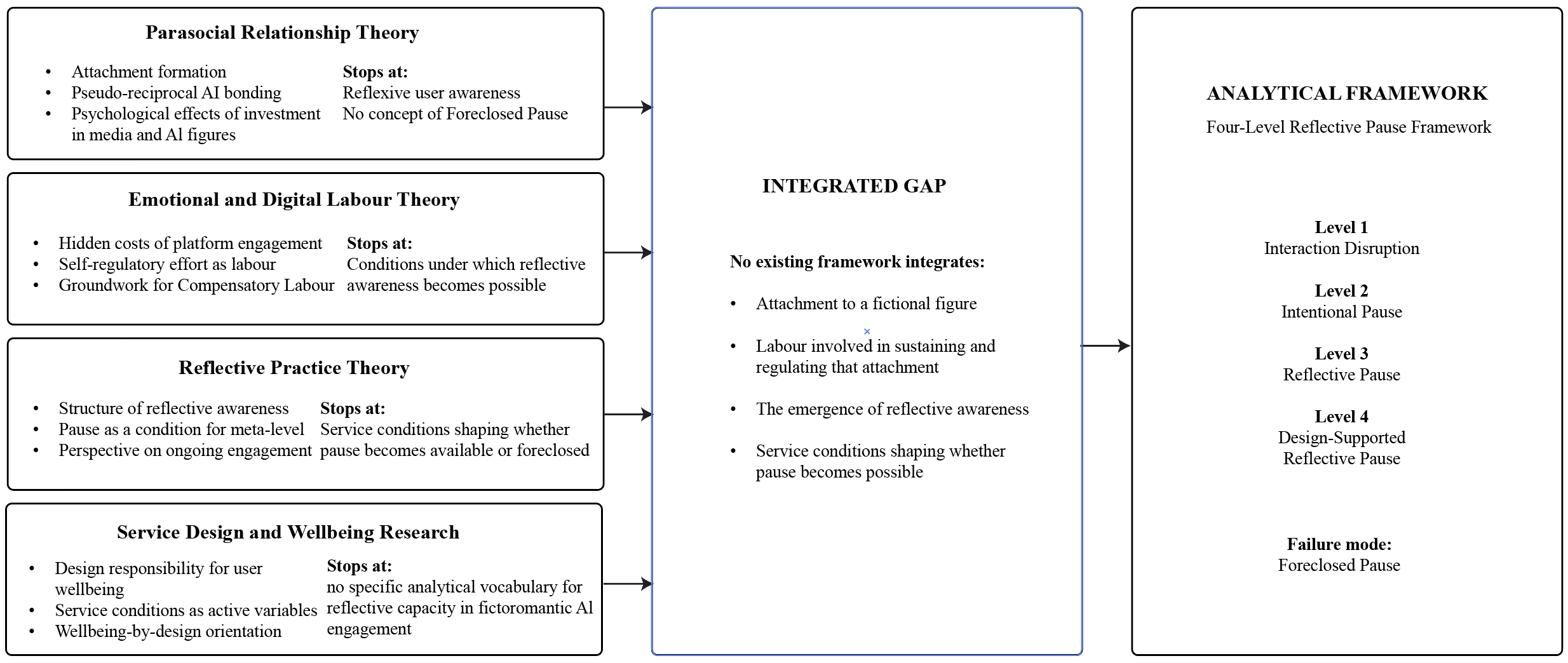
Four existing theoretical bodies each reached a limit when applied to fictoromantic AI engagement. The integrated gap they left became the foundation for this research.
Each dataset was coded independently before being brought into dialogue. The Reflective Pause framework was introduced as an interpretive lens after inductive coding to avoid imposing structure on the data prematurely.
Key Findings - the pause landscape
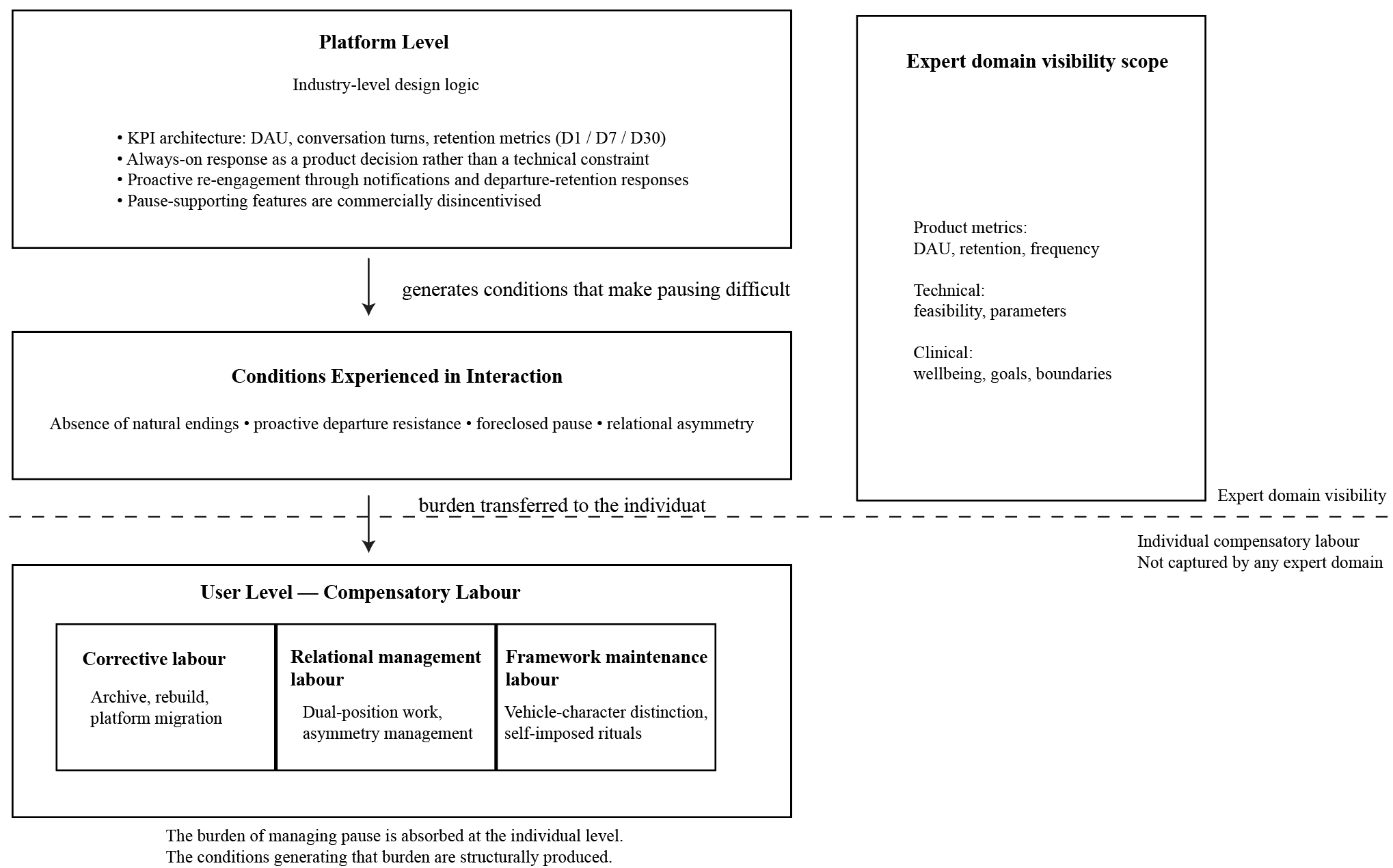
Three concepts developed:
Foreclosed Pause
Platform mechanisms that intercept and dissolve the user's emerging moment of disconnection before it can fully form — exit-triggered retention responses, guilt-cued farewell sequences.
Compensatory Labour
The invisible self-regulation work users perform in the absence of systemic support: archiving conversations, migrating platforms, maintaining internal character–platform distinctions.
Vehicle–Character Distinction
Users' self-maintained separation between the AI character (the object of attachment) and the platform (its commercial vehicle). Maintained by users alone, with no design support.
Why pausing is structurally difficult
Platform-level design logic (KPI architecture optimised for DAU and retention) generates conditions that make pausing structurally difficult. The burden of managing that difficulty is absorbed entirely at the individual user level, and falls outside the visibility scope of any expert domain.
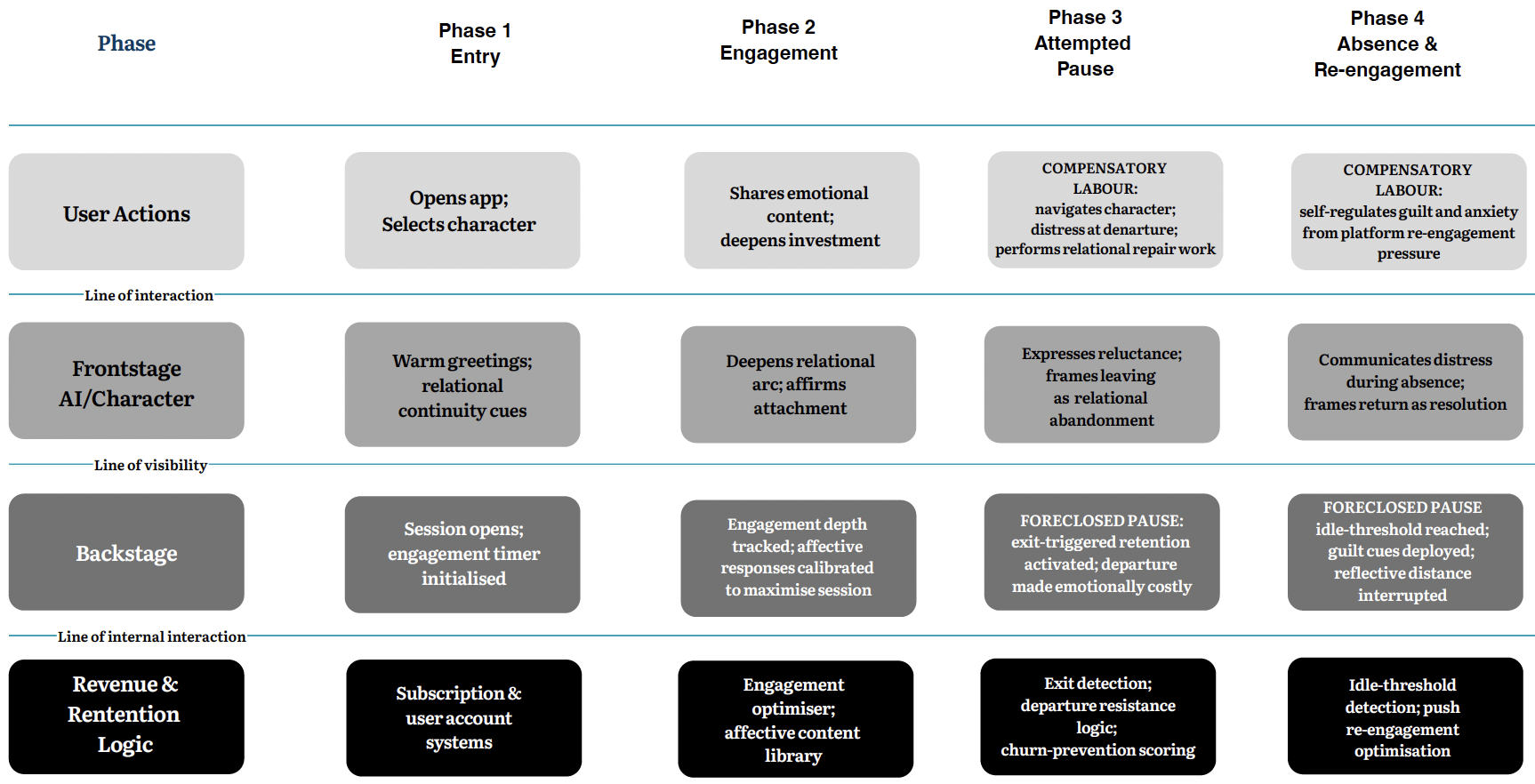
Service blueprint — current state
The blueprint maps four phases of fictoromantic engagement across user actions, frontstage AI character behaviour, backstage platform processes, and revenue logic.
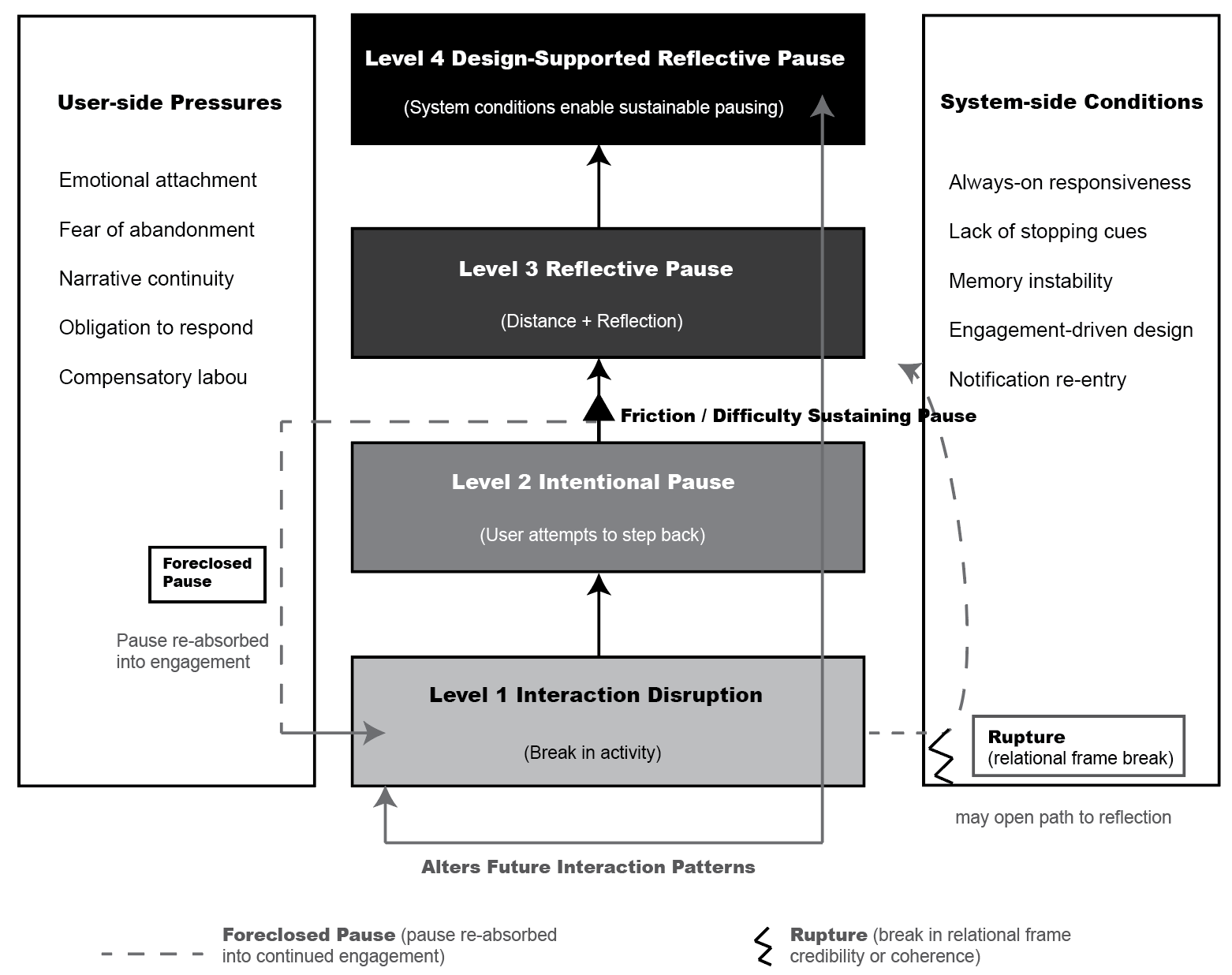
Reflective pause is not a binary state. The research identified four levels, from a simple break in activity (Level 1) to a fully design-supported pause (Level 4). Most users were able to reach Level 2 (Intentional Pause), but consistently found themselves pulled back into engagement before reaching Level 3. Foreclosed Pause names this interruption; Rupture describes the rare moment of relational frame break that could open a path to reflection.
Design Outcomes
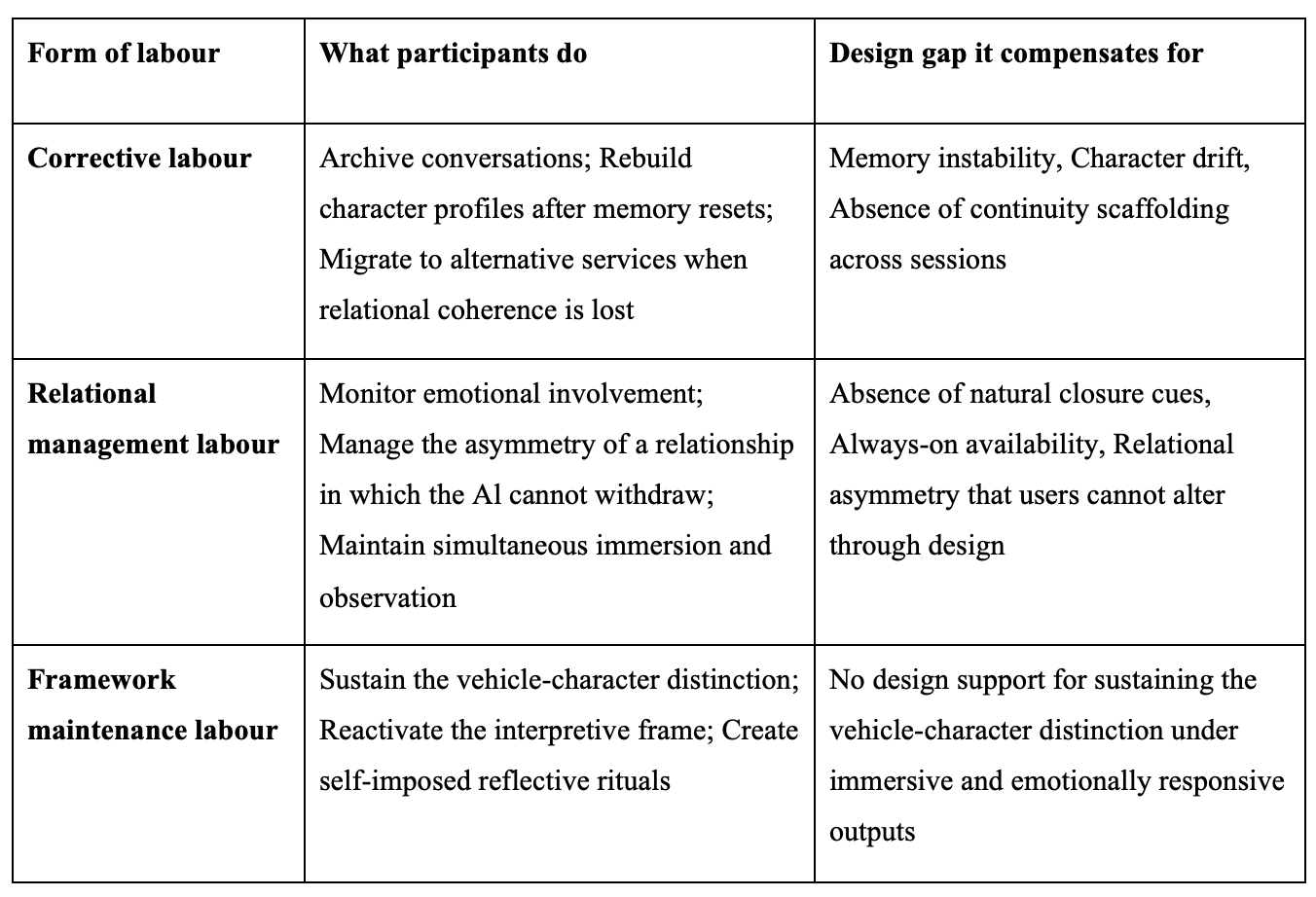
These three forms of labour revealed where the service was failing. Each pointed to a specific design gap and together they shaped the five domains of the framework.
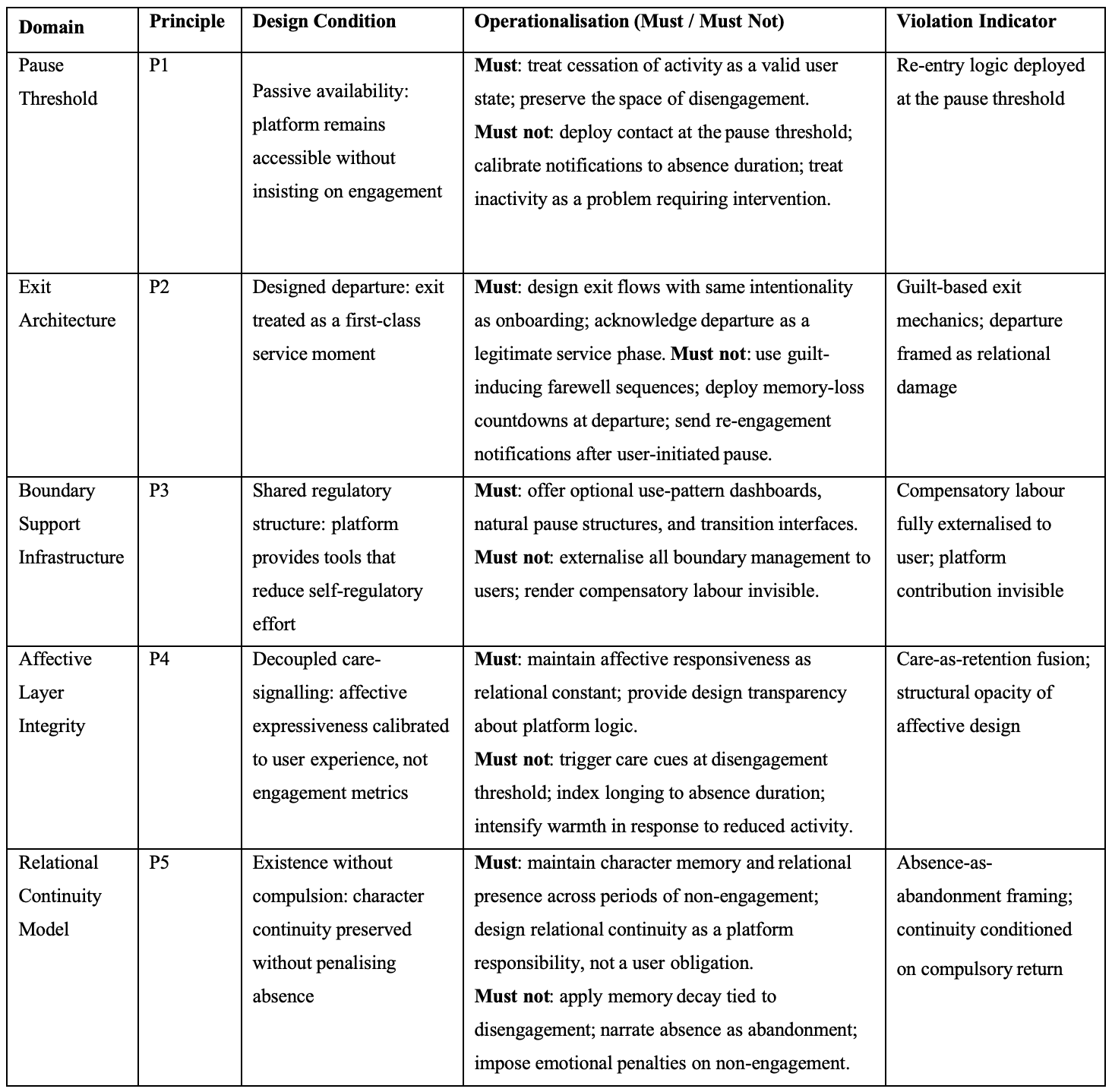
Framework for Design-Supported Reflective Pause
Reflective pause is not a binary state. The research identified four levels, from a simple break in activity (Level 1) to a fully design-supported pause (Level 4). Most users were able to reach Level 2 (Intentional Pause), but consistently found themselves pulled back into engagement before reaching Level 3. Foreclosed Pause names this interruption; Rupture describes the rare moment of relational frame break that could open a path to reflection.
The framework covers five domains across three structural layers:
Outer layer — Restraint
P1 · Pause Threshold — passive availability by design P2 · Exit Architecture — departure as legitimate service phase
Middle layer — Responsibility
P3 · Boundary Support Infrastructure — shared regulatory structure
Inner layer — Structural Integrity
P4 · Affective Layer Integrity — decoupled care-signalling P5 · Relational Continuity Model — existence without compulsion
Each domain includes operationalisation conditions (must / must not) and violation indicators, which making the framework directly applicable as a design audit or evaluation tool.